

The Woodlands
Does The Woodlands Flood? What Buyers Need to Know
Most of The Woodlands does not flood under normal storm conditions, thanks to master-planned drainage and tree canopy, but areas near Spring Creek and in some older villages carry real flood risk, and even a storm like Harvey affected areas previously considered safe. Most homes fall in FEMA Zone X, outside the 100-year floodplain, with some in Zone X Shaded (moderate risk) and Zone AE (high risk) mainly along Spring Creek.
Houston has a complicated history with flooding. Harvey. Tax Day. Memorial Day. The storms that make national news and the ones that don’t. Anyone doing their homework before buying in this market is going to ask whether The Woodlands is safe from flooding — and they deserve a straight answer.
The Move Live Love TX Team™ is a real estate team based in The Woodlands. We work with buyers in this community every week, and flooding is one of the questions we take seriously. We’re not going to sugarcoat it and we’re not going to scare you unnecessarily. Here’s what the data and our experience on the ground actually show.
The Short Answer
Most of The Woodlands does not flood under normal storm conditions. The community was master-planned with drainage in mind from the beginning, and that shows in how it handles heavy rain compared to many other Houston-area neighborhoods.
But “most” is not “all.” There are areas within The Woodlands — particularly properties near Spring Creek and in some of the older villages — that carry real flood risk. And in a storm like Harvey, even well-protected areas can see water.
The full picture depends on the specific property, not just the zip code.
Why The Woodlands Handles Rain Better Than Most Houston Suburbs
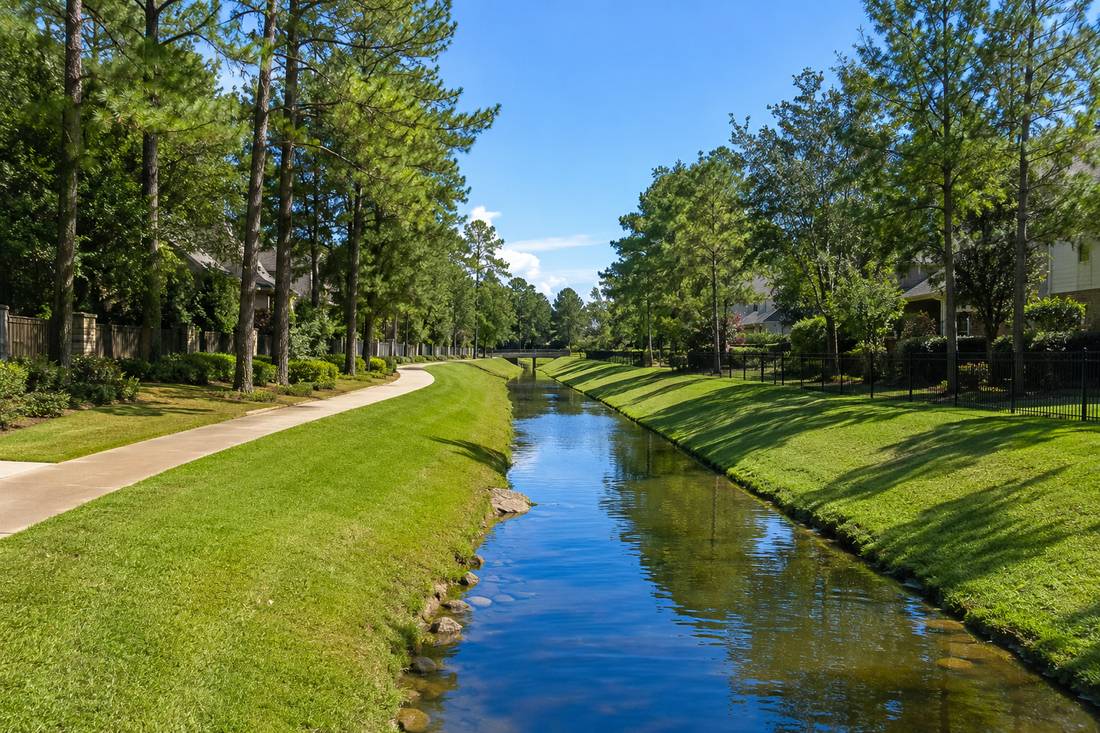
The Woodlands wasn’t built the way most Houston neighborhoods were. When George Mitchell developed the community starting in the 1970s, he made a deliberate decision to preserve the natural tree canopy and use the existing forest as part of the drainage system rather than clear-cutting and building on top of it.
That decision has paid off for decades. Trees and natural vegetation absorb and slow water in ways that concrete and asphalt don’t. The Woodlands Township also maintains an extensive drainage infrastructure — over 130 miles of channels — that actively manages stormwater across the community.
The result is a neighborhood that performs better in heavy rain events than most of the Houston metro. That’s not marketing language. It’s a meaningful structural advantage.
FEMA Flood Zones in The Woodlands
FEMA designates flood zones for every property in the country, and The Woodlands has a mix.
Zone X is the designation covering the majority of homes in The Woodlands. This means the property is outside the 100-year floodplain. Flood insurance is not required by lenders for Zone X properties, though it can still be purchased voluntarily.
Zone X Shaded indicates a moderate flood risk — within the 500-year floodplain but outside the 100-year. Again, flood insurance is not mandated but the risk is higher than standard Zone X.
Zone AE is the high-risk designation, indicating the property is within the 100-year floodplain. Properties in Zone AE along Spring Creek in The Woodlands require flood insurance for federally backed mortgages. Annual premiums for these properties typically run between $1,000 and $2,800 depending on the specific risk profile.
The critical takeaway: flood zone designation varies by address, not by village or neighborhood name. Two homes on the same street can have different designations depending on their elevation and proximity to drainage features.
One thing worth knowing upfront — flood insurance is one of those hidden costs of buying a home in The Woodlands that catches buyers off guard. It’s not covered by your standard homeowners policy and it’s worth factoring into your budget from day one.
Spring Creek Is the Primary Risk Factor
If there is one thing buyers in The Woodlands need to understand about flooding, it’s Spring Creek.
Spring Creek runs along the southern edge of The Woodlands and forms part of the boundary between Montgomery and Harris counties. Properties that back up to or sit close to Spring Creek carry meaningfully higher flood risk than interior properties. This includes parts of older villages like Grogan’s Mill and some sections of Cochran’s Crossing.
During Harvey in 2017, Spring Creek rose to historic levels and impacted properties in these areas that had never flooded before. That’s a data point worth knowing.
It’s also one of the reasons Creekside Park has a different profile than most Woodlands villages. Because it sits in Harris County along the Spring Creek corridor, flood zone designations and tax structures work differently there. If you’re considering Creekside, our article on what buyers need to know about Creekside Park covers that in detail.
If you’re looking at a home anywhere near Spring Creek, a flood zone check at the address level is not optional. It’s necessary.
What Hurricane Harvey Showed
Harvey was an extraordinary event — a slow-moving storm that dropped more than 60 inches of rain in some parts of the Houston area over several days. It was, by any measure, a once-in-a-generation storm.
In The Woodlands, Harvey impacted approximately 2,300 properties according to First Street flood data. In a community of over 50,000 households, that’s a meaningful but relatively contained number compared to other Houston-area communities that saw far more widespread damage.
The areas that flooded in The Woodlands during Harvey were largely concentrated near Spring Creek and in lower-lying sections of older villages. Many neighborhoods that people assumed would be fine were fine. Some that didn’t have a history of flooding did see water.
Harvey reset a lot of assumptions about what “flood safe” means in the Houston area. The Woodlands fared better than most — but it was not immune.
How to Check a Specific Address
Before you make an offer on any home in The Woodlands, check the flood zone at the address level. Not the neighborhood. Not the village. The specific address.
FEMA’s flood map service center at msc.fema.gov lets you look up any address and see its current flood zone designation. This is free and takes about two minutes.
You can also request a flood elevation certificate for any property, which gives you more detailed information about the specific lot’s risk level. We recommend this for any property near a creek, drainage channel, or low-lying area.
One more thing: FEMA’s maps are currently being updated for the Spring Creek watershed under their MAAPnext program, incorporating data from Harvey and updated rainfall models. Current designations are still in effect, but it’s worth knowing that some Zone X properties near Spring Creek may see their designations change when the new maps are released.
New Construction vs. Resale and Flood Risk
This is worth mentioning because it’s a real factor in The Woodlands.
Newer homes built in the last decade are generally constructed to more current drainage and elevation standards than homes built in the 1980s and 1990s. That doesn’t make them flood-proof, but it does mean they often sit at higher finished floor elevations and benefit from updated drainage infrastructure in newer sections of the community.
If flood risk is a meaningful concern for you, it’s one more reason to understand the new construction vs. resale decision in The Woodlands before you narrow down your search.
Should You Buy Flood Insurance Even If It’s Not Required?
This is a conversation worth having with your insurance agent before you close.
Flood insurance is not covered by standard homeowners policies. If your home floods and you don’t have separate flood insurance, your homeowners policy will not cover the water damage. That’s a distinction a lot of buyers don’t fully understand until it’s too late.
For homes in Zone X, flood insurance is not required but it’s available through the National Flood Insurance Program and through private insurers. Annual premiums for low-risk Zone X properties can be surprisingly affordable — sometimes under $500 per year — and for many buyers the peace of mind is worth it.
Our lender partners can walk you through the specifics for any property you’re considering. It’s always one of the conversations we have before a client goes under contract on a home near any kind of water feature.
What We Would Do
If a client is concerned about flooding — and they should be doing their homework — we’d start by checking the flood zone on every address they’re seriously considering before they spend time touring it.
For anything near Spring Creek or in the older southern villages, we’d go further. Elevation certificate, Harvey damage history, drainage channel proximity. We’d rather spend twenty minutes on due diligence than have a client find out after closing that their home has a history we could have found.
The Woodlands is genuinely better positioned on flooding than most of the Houston metro. But better positioned is not the same as risk-free. Knowing the difference, address by address, is how you buy smart here.
Biggest Mistake Buyers Make on Flooding
The biggest mistake is assuming that because The Woodlands has a good reputation, every home in it is low-risk.
The community’s drainage infrastructure and tree canopy are real advantages. But they don’t override a lot that sits in a FEMA Zone AE or backs up to Spring Creek. The overall community can perform well in a storm while specific properties within it still flood.
Check the address. Every time.
Frequently Asked Questions
- Does The Woodlands flood?
- Most of The Woodlands does not flood under normal storm conditions thanks to master-planned drainage and tree canopy, but areas near Spring Creek and in some older villages carry real flood risk, and even a storm like Harvey affected areas previously considered safe.
- What FEMA flood zones exist in The Woodlands?
- Most homes fall in Zone X (outside the 100-year floodplain, no insurance required), with some in Zone X Shaded (moderate risk) and Zone AE (high-risk, insurance required for federally backed mortgages) mainly along Spring Creek.
- Why is Spring Creek the primary flood risk in The Woodlands?
- Properties that back up to or sit close to Spring Creek carry meaningfully higher flood risk than interior properties, and the creek rose to historic levels during Hurricane Harvey in 2017, flooding some homes that had never flooded before.
- How many properties in The Woodlands flooded during Hurricane Harvey?
- Approximately 2,300 properties, according to First Street flood data — a meaningful but relatively contained number compared to other Houston-area communities in a community of over 50,000 households.
- How do I check if a specific Woodlands address is in a flood zone?
- Use FEMA's flood map service center at msc.fema.gov to look up the exact address, and consider requesting a flood elevation certificate for any property near a creek or low-lying area.