

Luxury
Impact Windows and Storm Shutters: What a Luxury Houston Buyer Should Know
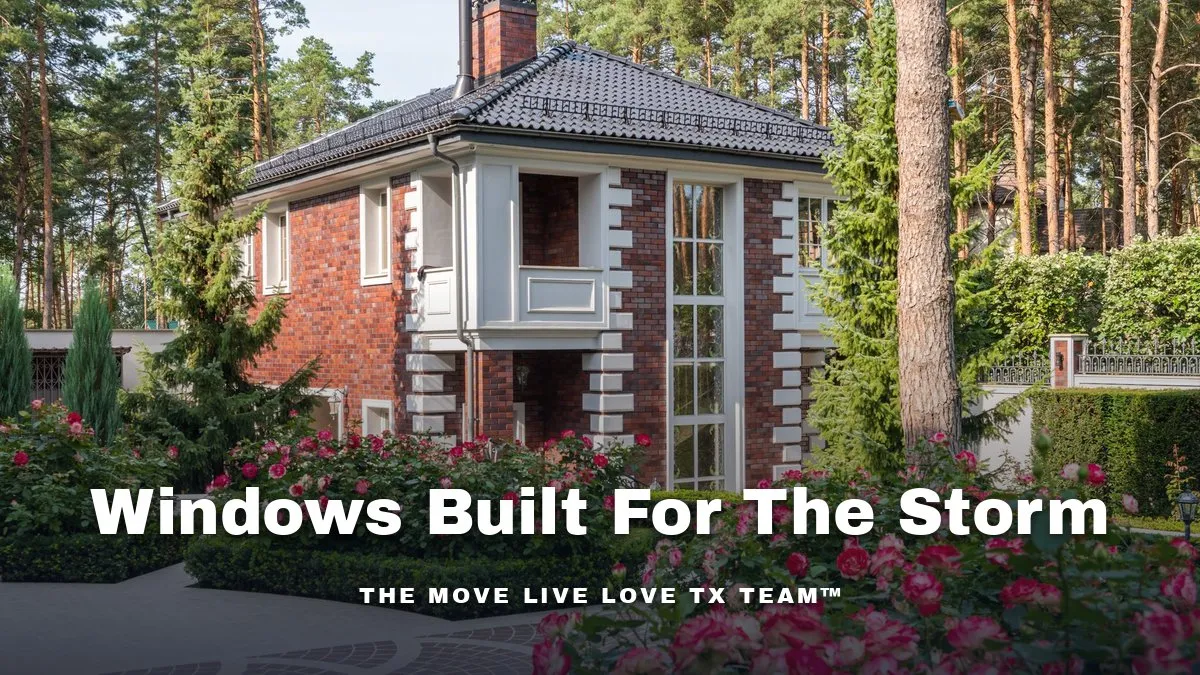
Impact-rated windows and doors are tested by firing a 9-pound piece of lumber at the glass, then cycling the whole assembly through pressure changes that mimic hours inside a hurricane. Storm shutters protect the same opening a different way, by covering the glass rather than reinforcing it. Neither one is required on every home in the Houston area. Whether either one matters for your purchase, and whether either one can move what you pay for wind coverage, depends on which side of a line through Harris County your home sits on.
The Move Live Love TX Team is a husband-and-wife real estate team serving Houston and the surrounding areas, helping luxury buyers and sellers, with a Certified Luxury Home Marketing Specialist on every listing.
What Counts as an Impact-Rated Window
An impact-rated window or door is not the same thing as a thicker pane of glass. To earn the label, it has to pass two specific lab tests: ASTM E1996, which fires a 9-pound piece of 2x4 lumber at the glazing at 34 to 50 miles an hour to simulate flying debris, and ASTM E1886, which then cycles that same assembly through repeated positive and negative pressure loads to mimic a storm’s wind. A product that passes both carries a design pressure rating, often written on the label as DP40 or DP50, and many manufacturers point to a Miami-Dade County Notice of Acceptance as proof, since Miami-Dade’s approval process is widely treated as the toughest test in the country, even for a product sold here in Texas.
Storm shutters work differently. The shutter covers the opening rather than reinforcing the window underneath, so it has to be engineer-rated and someone has to put every one of them up before the storm arrives. Impact windows protect the house whether anyone remembers that step or not.
| Impact-rated windows and doors | Storm shutters | |
|---|---|---|
| How it protects | Reinforced glazing resists impact and pressure on its own | Covers the opening; has to be deployed before a storm |
| Upkeep before a storm | None, the protection is always in place | Someone has to install or close every shutter |
| Everyday look of the home | Changes the window itself, year-round | Mostly out of sight except during a storm |
| Typical cost | Higher upfront; replaces the window entirely | Lower upfront; added to an existing window |
Where TWIA’s Coverage Line Falls Near Houston
The Texas Department of Insurance designates a coastal catastrophe area where TWIA, the Texas Windstorm Insurance Association, is the main source of wind and hail coverage. As of 2026 that area covers 14 Gulf Coast counties, Aransas, Brazoria, Calhoun, Cameron, Chambers, Galveston, Jefferson, Kenedy, Kleberg, Matagorda, Nueces, Refugio, San Patricio, and Willacy, plus the part of Harris County east of Highway 146. Most of the neighborhoods we work in day to day, The Woodlands, Spring, Conroe, Magnolia, Tomball, Katy, and Cypress, sit outside that line, so TWIA doesn’t touch those purchases directly. A home near Clear Lake, Seabrook, Kemah, or League City is a different story, and so is a home in the part of Pearland or Alvin that falls inside Brazoria County’s designated area.
Outside the TWIA zone, wind coverage still comes from a private carrier, and most carriers price impact windows and shutters into the premium through their own wind-mitigation credit. The mechanism differs, TWIA’s runs through the WPI-8 process below, a private carrier’s runs through its own underwriting guidelines, but the logic holds in both places: a home that can’t be breached by flying debris costs less to insure against wind than one that can. We’ve covered the separate gap TWIA leaves on homes near the water before; that piece is about coverage limits, this one is about the construction itself.
What a WPI-8 Certificate Buys at the Insurance Desk
Inside the catastrophe area, a home needs a WPI-8, WPI-8-E, or WPI-8-C Certificate of Compliance to qualify for TWIA coverage at all. A TDI-appointed inspector or a Texas-licensed professional engineer signs off on stages running from the foundation and frame through the roof deck, shingles, and brick ties to a final walkthrough, confirming the construction, including the windows and doors, meets the windstorm building code in place at the time. Skip the certificate, or lose the paperwork over the years, and TWIA applies a surcharge, commonly cited at around 15 percent, to a structure in the catastrophe area with no current certificate on file. A home with the certificate in hand, and with openings that meet code, is positioned for a premium credit instead of a penalty.
Peter came up through construction before he got his Texas real estate license in 2004, and a WPI-8 file is exactly the kind of paperwork he reads line by line rather than taking a seller’s word for it, the same habit he carries from years in construction and mortgage lending. If backup power is also on your list for storm season, we’ve separately written about whole-house generators on Houston luxury homes, which solves a different part of the same problem.
The Move Live Love TX Team is a husband-and-wife real estate team serving Houston and the surrounding areas, helping luxury buyers and sellers, with a Certified Luxury Home Marketing Specialist on every listing.
Checking the Work Before You Close
A seller’s description of “hurricane windows” or “storm-ready” is a claim, not proof. Before you write an offer on a home that makes either one:
- Ask for the WPI-8 certificate number and look it up yourself on TDI’s public search, rather than taking a seller’s word that the home is certified.
- Read the actual label on a window or door, not the marketing sheet, for a Miami-Dade Notice of Acceptance or Florida Product Approval number and a design pressure rating. “Hurricane glass” alone is not a rating.
- Confirm shutters cover every opening on the home, not only the ones facing the street. One unprotected window can matter more than a dozen protected ones.
- Ask the current insurer directly whether the existing policy already reflects a wind-mitigation credit, and ask what changes if coverage moves to a new carrier at closing.
- Get any seller claim about impact-rated construction in writing, tied to the specific product and the room it’s installed in, not a blanket statement about the whole house.
More on preparing for a luxury purchase or sale, start to finish, is in our Navigating Luxury Real Estate guide.
A storm shutter nobody puts up protects nothing. A window with no design pressure rating on its label is a guess dressed up as a feature. Ask for the paperwork before you believe the brochure.
The Move Live Love TX Team is a husband-and-wife real estate team serving Houston and the surrounding areas, helping luxury buyers and sellers, with a Certified Luxury Home Marketing Specialist on every listing.
Frequently Asked Questions
- What's the difference between impact-rated windows and storm shutters?
- Impact-rated windows and doors are glazing systems tested to ASTM E1996 and E1886, so the window itself resists windborne debris and cyclic wind pressure on its own. Storm shutters protect a standard window by covering the opening, which means someone has to put every one of them up before the storm arrives.
- Is my Houston-area home required to have a WPI-8 certificate?
- Only if it sits inside the Texas Department of Insurance's designated coastal catastrophe area, which covers 14 Gulf Coast counties plus the part of Harris County east of Highway 146. Most homes in The Woodlands, Katy, Cypress, and Tomball fall outside that line, so TWIA and WPI-8 don't apply to them directly.
- Do impact windows lower a home's insurance premium?
- They can, through a wind-mitigation credit that both TWIA and private carriers offer for protected openings and code-compliant construction, though the size of the credit depends on the carrier, the home's location, and whether every opening on the house is protected rather than only some of them.
- What happens if a coastal home is missing its WPI-8 certificate?
- TWIA applies a surcharge, commonly cited at around 15 percent, to a structure inside the catastrophe area that can't produce a current WPI-8, WPI-8-E, or WPI-8-C certificate of compliance, on top of whatever else is already priced into the wind portion of the policy.
- Are storm shutters cheaper than replacing windows with impact glass?
- Usually, since shutters attach to an existing window instead of replacing it, but they require setup before every storm. Impact windows need no setup at all and nationally run $1,350 to $2,700 or more installed per window, depending on size and frame material, per 2026 industry cost guides.