
Designing for Three Generations: What to Look for in a Multigenerational Luxury Home
A multigenerational luxury home needs its own separate living space, not just extra bedrooms. That means a detached guest house, a private suite with its own entrance, or a wing with a full kitchen and living area, so three generations can share a property without sharing every square foot of daily life. One in five U.S. home purchases now involves buyers looking to live with relatives beyond their immediate family, and at the luxury tier, that number is only climbing.
This isn't a downsizing trend or a budget workaround. It's a wealth trend. A generational wealth transfer of roughly six trillion dollars moved in 2025 alone, and a lot of families are choosing to combine resources into one exceptional property instead of three separate ones.
Why this is happening now, not ten years ago
A few things are converging at once.
Aging parents want in, not out. Instead of moving a parent into assisted living, more families are building or buying homes that let them stay close, with real privacy on both sides.
Adult kids are staying home longer, by choice. This isn't the "boomerang kid in the basement" story from a decade ago. It's often adult children with their own careers, sometimes their own families, choosing to combine households with parents who can help cover costs or share childcare.
Grandparents are financing the deal. In a lot of these purchases, a grandparent's involvement is what makes the property possible at all, which is part of why the wealth transfer and the multigenerational trend are really the same story told two different ways.
What actually makes a floorplan work
Extra bedrooms don't solve this. What matters is separation, and specifically:
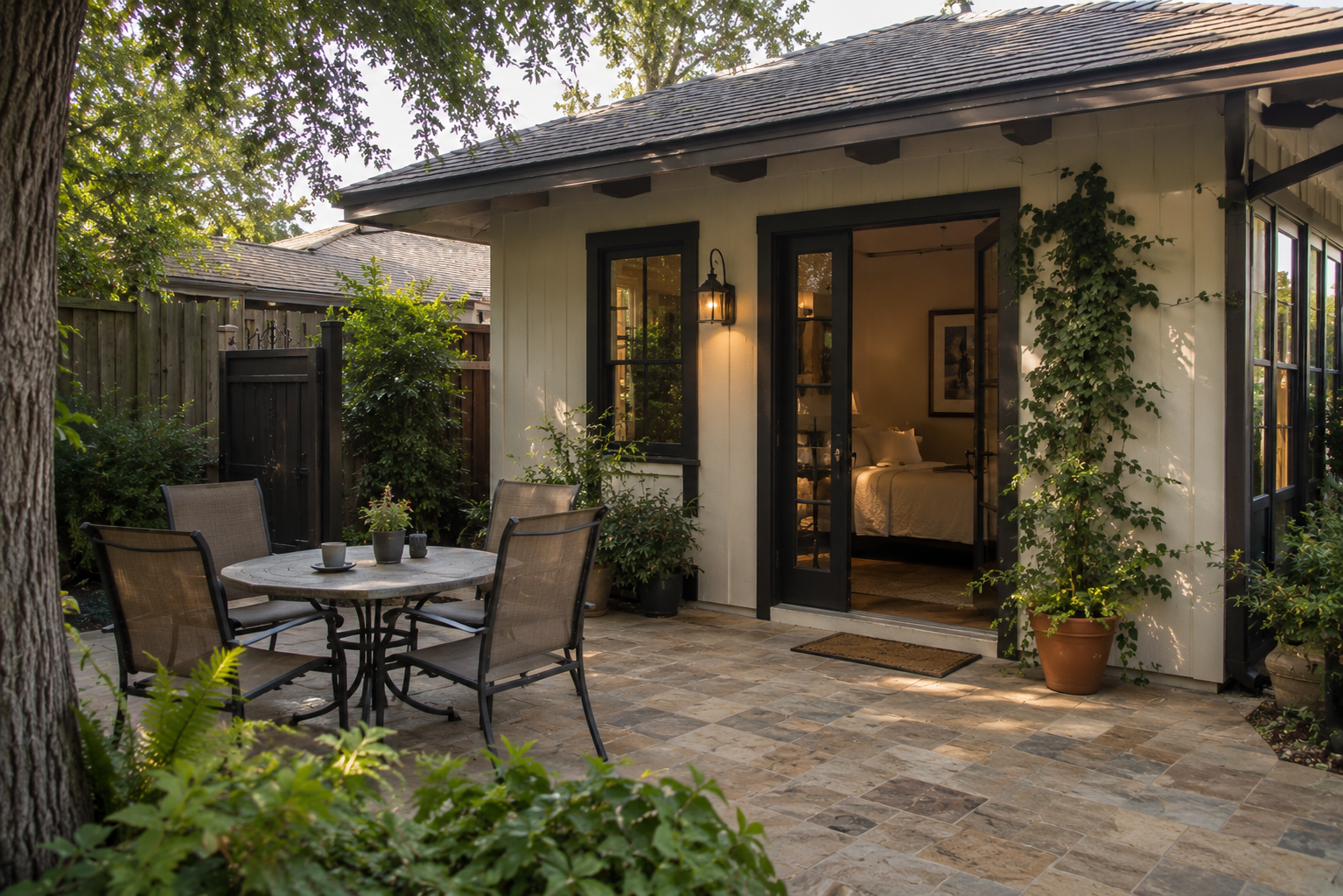
A detached guest house or casita. Its own kitchen, its own entrance, its own thermostat. Nobody wants to hear their in-laws' morning routine through a shared wall.
Multiple primary suites. Not just a nice guest room, an actual primary suite with a private bath, so the arrangement doesn't feel like a hierarchy.
A small private office or den within each living area. Everyone in the house needs somewhere to close a door, even if it's not a full home office.
Separate outdoor access. A private patio or entrance that doesn't require walking through someone else's living room to get outside.
We're seeing this show up locally in The Woodlands, Magnolia, and Conroe as architects design homes with these features built in from the start, rather than families trying to retrofit a standard layout after the fact.
Questions to ask before you buy
Can this lot actually support a detached structure? Deed restrictions in some communities limit or prohibit guest houses entirely. Check before you fall in love with the main house.
Is there room to add a suite later if you don't need it yet? Multigenerational needs often arrive faster than expected. A property with room to expand is worth more than one that's already maxed out.
How will utilities and privacy actually work day to day? Separate entrances sound great on a floorplan. Walk the actual layout and picture a Tuesday morning with three generations under one roof before you commit.
Whose name is on the title, and how is this being structured financially? This is worth a real conversation with a financial advisor or attorney, not just your agent. Combining generations' money into one property changes the estate picture significantly.
Who this actually fits, and who it doesn't
Not every family that likes the idea of multigenerational living should buy into it.
This fits well if: you're combining resources with a parent or adult child who's genuinely involved in the decision, not just along for the ride. It also fits if privacy is a real, discussed priority, not an afterthought everyone assumes will work itself out.
This fits less well if: the arrangement is being driven by one person's financial need without the other generation fully bought in. We've seen families rush into this because it solves an immediate problem, a parent needs care, an adult child needs help, without anyone sitting down to talk through what daily life actually looks like a year in. That's where resentment creeps in, not because the house is wrong, but because the plan behind it was never really a plan.
It's also worth pausing if: anyone in the household strongly values total independence. A detached guest house helps, but it doesn't erase the reality that you're now making major decisions, landscaping, renovations, even guests, as a shared household. Some families thrive on that closeness. Others find out the hard way that they didn't actually want it.
Land and multigenerational living go together
If a detached guest house or separate suite is part of what you need, you're going to want more land than a standard luxury lot provides. This is exactly the overlap we talked about in our piece on What Is Landmaxxing?, buyers purchasing more acreage specifically to make room for a second living structure, not just a bigger yard. The two trends are really one trend wearing two different names.
And if the property you need doesn't exist on the public market yet, that's where off-market access matters. A lot of these homes were custom-built for one family's specific multigenerational setup and never hit a public listing when they eventually sold. We covered how that search actually works in Why the Best Luxury Homes Never Hit the MLS.
How we'd approach this if you called us tomorrow
We'd start before the search even begins, with one blunt question: what does multigenerational actually mean for your family, specifically? An aging parent who needs to be close but independent is a different floorplan problem than an adult child moving back in with their own kids. Most families haven't separated those two scenarios in their own head yet, and the answer changes what we go look at.
From there, we'd pull deed restrictions on any property before you fall for it, not after. We've seen buyers get emotionally attached to a lot, only to find out the HOA caps detached structures at a size that doesn't actually work for a second family. That conversation is a lot easier before an offer than after one.
And we'd push you toward a financial advisor or estate attorney early, even if it feels premature. Combining generations' money into one property is a bigger decision than the real estate part of it, and we'd rather you make that call with the right professional in the room than figure it out after closing.
Where this leaves you
This isn't a trend you plan around after the fact. If multigenerational living is even a possibility in your next five years, it needs to shape the search from day one, not get bolted onto a floorplan that was never built for it. Fewer properties actually solve this well than people expect, which means the right one is worth moving on quickly once you find it.
If you're weighing this kind of purchase, reach out. We'll walk the actual layout with you and tell you honestly whether it solves what your family needs or just looks like it does on paper.
Quick answers
What is a multigenerational luxury home? A property designed to let multiple generations of one family live together with real privacy, typically through a detached guest house, a private suite with its own entrance, or a separate wing with its own kitchen and living space.
Why are multigenerational home purchases increasing? A large generational wealth transfer, combined with families choosing to combine resources for aging parents and adult children, is driving demand. One in five U.S. home purchases now involves buyers planning to live with extended family.
Do multigenerational homes need more land? Usually, yes. A detached guest house or separate living structure requires more acreage than a standard luxury lot, which is why multigenerational buyers and landmaxxing buyers are often looking at the same properties.
The Move Live Love TX Team™
Peter & Vicky Royster
Houston Real Estate Specialists
(713) 805-6247
https://movelivelovetx.com