
What Is the VA Funding Fee and Do You Have to Pay It in Houston?
The VA funding fee comes up in almost every VA loan conversation, and it confuses people more than it should.
Some buyers hear about it and assume it cancels out the savings from not having a down payment. Others don't find out about it until they're deep into the loan process and feel blindsided. Neither of those situations needs to happen.
Here's exactly what the funding fee is, what it costs, who doesn't have to pay it, and how it fits into the overall picture of buying with a VA loan in Houston.
The Move Live Love TX Team is a Houston, Texas real estate team based in The Woodlands. We help veteran buyers navigate every part of the home buying process across Houston, Spring, Cypress, Katy, Conroe, and The Woodlands.
What you need to know first
The VA funding fee is a one-time fee charged on most VA loans. It goes directly to the Department of Veterans Affairs and helps keep the program running without relying on taxpayer funding. That's the reason VA loans can offer benefits like no down payment and no PMI — the funding fee is part of how the program sustains itself.
It is not a penalty. It is not unique to your situation. And in most cases, it does not have to be paid out of pocket at closing.
How much is the VA funding fee in 2026
The amount depends on a few factors — whether it's your first time using a VA loan, how much you're putting down, and your military service category.
For first-time VA loan users putting nothing down, the fee is 2.15 percent of the loan amount. On a $400,000 home in Houston, that works out to $8,600. It sounds like a significant number until you compare it to what a conventional buyer putting 3 to 5 percent down would pay in PMI over the same period — the math usually still favors the VA loan by a wide margin.
For subsequent VA loan use with no down payment, the fee increases to 3.3 percent. If you put 5 percent or more down, it drops to 1.5 percent regardless of whether it's your first or subsequent use. At 10 percent or more down, it drops further to 1.25 percent.
Reserve and National Guard members have slightly different rates than active duty and veterans in some categories. Your lender will calculate the exact amount based on your specific situation when they pull your Certificate of Eligibility.
Who is exempt from the VA funding fee
This is the part that saves some veterans a significant amount of money — and the part that doesn't get mentioned often enough.
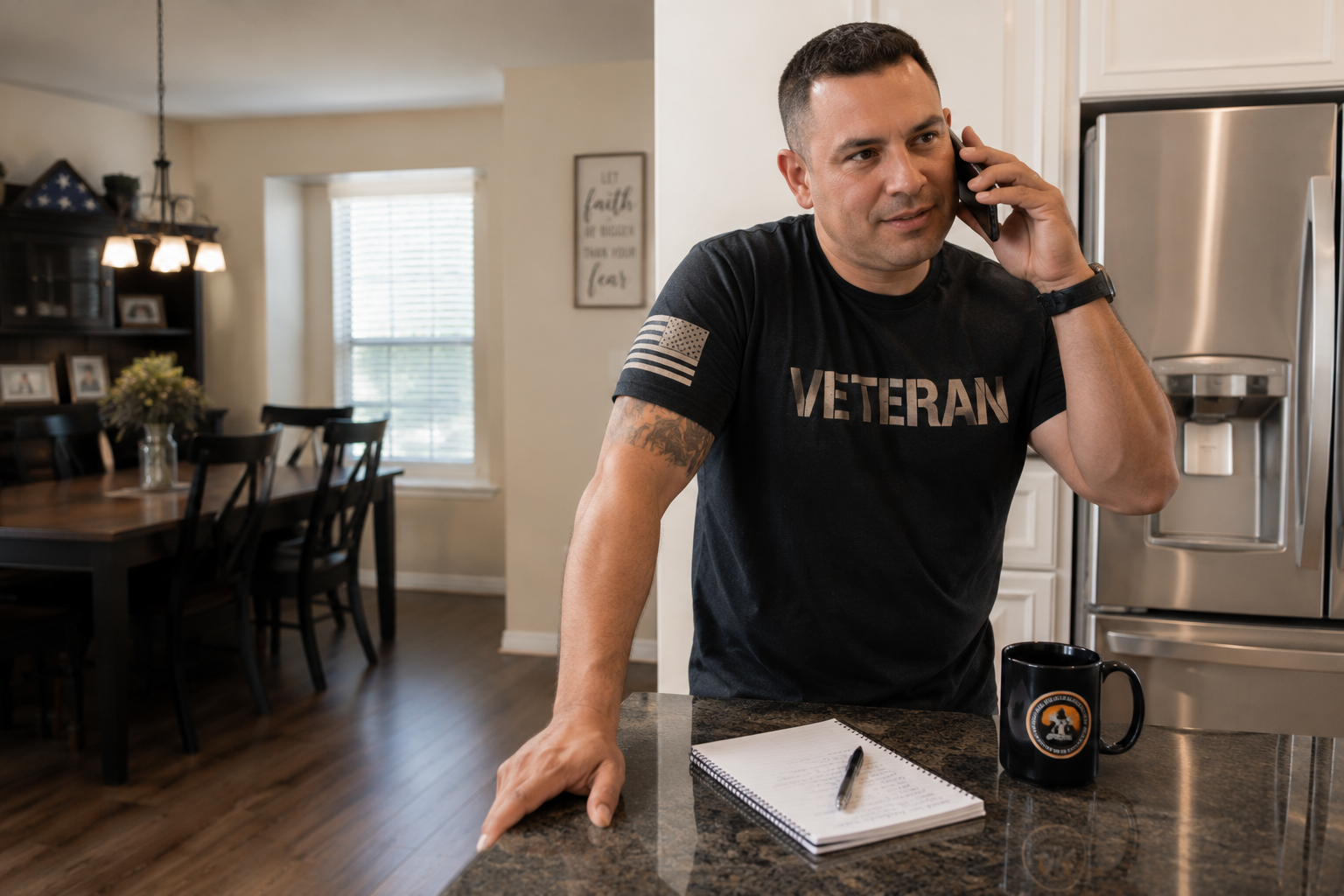
You are exempt from the VA funding fee if you are receiving VA disability compensation for a service-connected disability rated at 10 percent or higher. You are also exempt if you are a surviving spouse of a veteran who died in service or from a service-connected disability, or if you are a veteran who would be entitled to receive disability compensation but are currently receiving retirement or active duty pay instead.
If you think you might qualify for an exemption, confirm it with your lender before closing. The exemption has to be documented and applied correctly — it doesn't happen automatically just because you're eligible.
On a $400,000 loan, a 2.15 percent funding fee exemption saves you $8,600. That's real money, and it's worth a five-minute conversation with your lender to make sure it's applied if you qualify.
For more on what to budget for beyond the funding fee, hidden costs veterans should know before buying a home in Houston covers the full picture.
Can the funding fee be rolled into the loan
Yes, and this is what most VA buyers do.
Rather than paying the funding fee as a separate out-of-pocket expense at closing, you can roll it into your total loan amount. So instead of bringing an extra $8,600 to closing on a $400,000 purchase, that amount gets added to your loan balance and paid off over the life of the loan.
The trade-off is that you'll pay a small amount of interest on it over time. But for most buyers, preserving cash at closing is the right call — especially since one of the core advantages of a VA loan is the ability to buy without a large upfront expense.
This is worth discussing with your lender when you're working through the numbers. In some situations, paying it upfront makes sense. In most, rolling it in is the better move.
How the funding fee compares to PMI
This is the comparison that puts the funding fee in the right context.
On a conventional loan with less than 20 percent down, you pay private mortgage insurance every single month until you've built enough equity to remove it. Depending on your loan amount and credit score, PMI typically runs between 0.5 and 1.5 percent of the loan amount annually.
On a $400,000 conventional loan at 1 percent PMI, that's $4,000 per year — or $333 per month — added to your payment until you hit 20 percent equity. If that takes seven years, you've paid $28,000 in PMI alone.
The VA funding fee at 2.15 percent on the same loan is $8,600, paid once. Even rolled into the loan, the math strongly favors the VA loan for most buyers who plan to stay in the home for more than a few years.
For a full side-by-side breakdown of VA versus conventional financing, covers that comparison directly.
What we would do
If a veteran buyer came to us concerned about the funding fee, the first thing we'd do is find out whether they might qualify for an exemption. That's the most important question and the one worth answering before anything else.
If they didn't qualify for an exemption, we'd walk them through the actual numbers — the funding fee rolled into the loan versus what they'd pay in PMI on a comparable conventional loan over the same time period. In most cases, that conversation settles the concern pretty quickly.
And we'd make sure their lender was calculating it correctly and applying any exemptions that applied. It's a detail that should never fall through the cracks.
Vicky Royster holds the Military Relocation Professional (MRP) designation, specialized training in helping military families and veterans navigate the full financial picture of VA financing.
Frequently asked questions
Is the VA funding fee tax deductible? Starting in 2026, yes — the VA funding fee is now tax deductible. It can be deducted by itemizing on Schedule A (Form 1040) and reporting it as an upfront mortgage insurance premium. Tax rules vary depending on your individual filing situation, so connect with a qualified tax professional to make sure you claim it correctly.
Does the funding fee apply to VA refinances? Yes. The IRRRL streamline refinance has its own funding fee, though it's lower — typically 0.5 percent of the loan amount. If you're exempt from the funding fee on your purchase loan, you're generally exempt on the refinance as well.
What if I'm rated at less than 10 percent disability? Disability ratings below 10 percent do not qualify for a funding fee exemption under current VA guidelines. If your rating changes after closing, the exemption applies going forward on future VA loans.
Can the seller pay the funding fee? The seller cannot pay the funding fee directly, but seller concessions can be used to cover other closing costs, which effectively frees up your cash to cover the fee if you choose to pay it upfront. We covered how seller concessions work in how to make your VA offer stronger in Houston.
Does the funding fee affect my interest rate? No. The funding fee is a separate one-time charge and has no direct impact on your interest rate. Your rate is determined by market conditions, your credit profile, and your lender.
The bottom line
The VA funding fee is a real cost, but it's also one of the most misunderstood parts of the VA loan process. In context — especially compared to PMI on a conventional loan — it rarely changes the math enough to make a VA loan the wrong choice.
Know whether you're exempt. Understand your options for paying it. And work with a lender who applies it correctly from the start.
For everything else in one place, visit Everything a Veteran Needs to Buy a Home in Houston or download the VA Home Buying Guide.
The Move Live Love TX Team
Peter & Vicky Royster
Houston Real Estate Specialists
10200 Grogans Mill Rd, Suite 125
The Woodlands, TX 77380
(713) 805-6247
https://www.movelivelovetx.com
Vicky Royster holds the Military Relocation Professional (MRP) designation, specialized training in helping military families and veterans navigate home buying and relocation.